
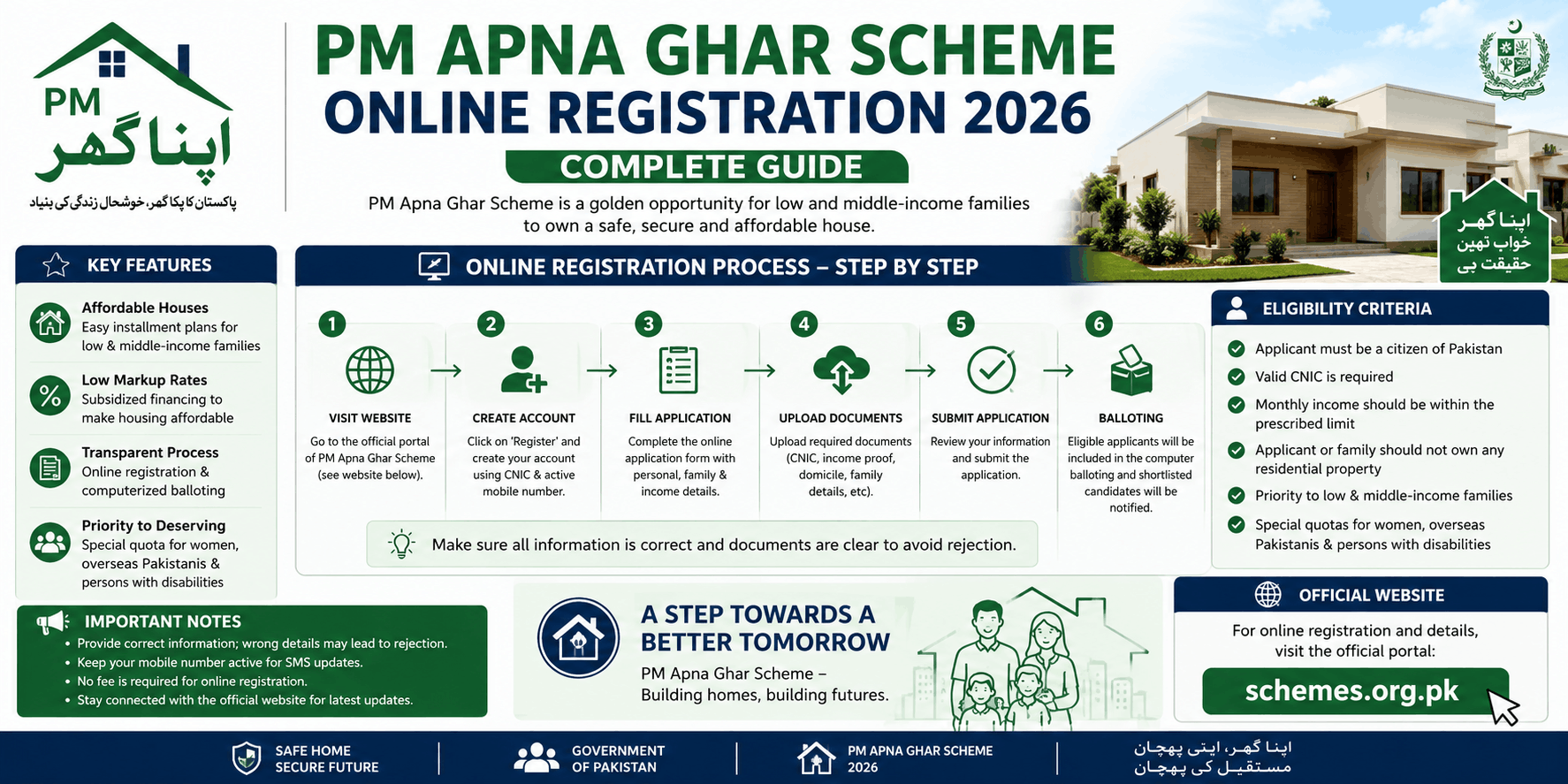
PM Apna Ghar Scheme Online Registration 2026 Complete Guide

The Wazir-e-Azam Apna Ghar Program 2026 is a government-backed housing finance initiative designed to help low and middle-income families transition from rented homes to ownership. With Rs. 3.2 trillion allocated and a target of financing 500,000 homes within 5 years, the scheme is a cornerstone of Pakistan’s housing and economic development plan.The PM Apna Ghar Scheme Online Registration gives eligible families a chance to apply for low‑markup housing loans and government-backed support all through a simple online process designed to make homeownership more accessible and transparent.
Also read: CM Punjab Rehmat Card 2026 Apply Online & Check Eligibility
What Is PM Apna Ghar Scheme 2026 in Pakistan?
The PM Apna Ghar Scheme (often connected with Apni Chhat Apna Ghar Scheme) is a low-income housing initiative backed by the Government of Pakistan.
Its main goal is simple:
- Help low- and middle-income families build or purchase houses
- Provide low-markup loans through partner banks
- Offer installment-based repayment plans
- Make home ownership accessible instead of elite
In 2026, the scheme is aligned with provincial housing initiatives especially in Punjab and banking partners like Bank of Punjab (BOP) and other SBP-regulated institutions.
Eligibility Criteria
- First-time homeowners: Neither applicant nor spouse should own a house in Pakistan.
- Pakistani citizenship: Valid CNIC required.
- Income group: Primarily aimed at low and middle-income families.
- Property types covered: Houses up to 10 Marla, apartments up to 1,500 sq ft, or residential plots for construction.
PM Apna Ghar Scheme Online Registration Step by Step Process
Follow these steps:
- Visit official portal: Apply via the pha.gov.pk
- Choose bank: Options include HBL, Bank Alfalah, Meezan Bank, Allied Bank, and others.
- Fill application form: Provide CNIC, income proof, and property details.
- Submit digitally: Upload required documents online.
- Loan processing: Banks review eligibility and issue approval.
Why This Scheme Matters
- Affordable housing: Enables families to escape the rent trap.
- Economic growth: Boosts construction sector and job creation.
- Financial stability: Fixed markup shields families from market volatility.
- Inclusive coverage: Available across all provinces including Punjab, Sindh, KPK, Balochistan, Gilgit-Baltistan, and Azad Kashmir.
Loan & Installment Details Under PM Apna Ghar Scheme
This is the most important section.
How Much Loan Can You Get?
Depending on category:
- Up to PKR 1.5 million
- Some provincial programs allow up to PKR 2.5 million
- Installment plans up to 20 years
Loan amount depends on income and repayment capacity.
Common Reasons Applications Get Rejected in Pakistan
Based on bank review patterns:
1. Insufficient Income Proof
Cash earners without documentation struggle with approval. Maintain bank transactions.
2. Poor Credit History
Banks check previous loan repayment behavior.
3. Incorrect CNIC Information
NADRA mismatch leads to immediate rejection.
4. Incomplete Documents
Missing bank statements or affidavits delay processing.
FAQs
1. How can I apply for PM Apna Ghar Scheme 2026 in Pakistan?
Visit the official housing scheme website, create an account using CNIC, fill the form, upload documents, and submit.
2. What documents are required?
CNIC, income proof, bank statements, photo, and non-ownership affidavit.
3. What is the maximum loan amount?
Typically between PKR 1.5 million to PKR 2.5 million depending on program category.
4. What is the markup rate?
Subsidized rates range from 3% to 7%.
5. Can government employees apply?
Yes, if they meet income and property criteria.
6. How long does approval take?
Usually 30–90 days after verification.
Conclusion
If you’re serious about owning a home in Pakistan, the PM Apna Ghar Scheme 2026 is one of the most practical opportunities available right now. It’s not a shortcut to a free house. It’s a structured, government-supported pathway that makes home ownership possible through low-markup loans, long repayment tenures, and transparent eligibility criteria. For low- and middle-income families who feel stuck paying rent year after year, this scheme can shift the equation.